Ask anyone who has managed more than a handful of locations the same question and you'll hear a familiar answer: the hardest part wasn't opening the next site. It was keeping everything already open organized, visible and moving forward.
That's the problem Sitehub Suite was built to solve.
Built From Decades of Operational Experience
Sitehub Suite didn't begin as a product idea. It grew from decades of experience supporting multi-location portfolios and seeing the same operational challenges repeat across otherwise very different organizations.
A permit renewal lives in someone's personal calendar. A critical obligation is buried in an email thread. A location record contains an address and lease date but doesn't clearly show who is responsible for what. When an experienced team member leaves, years of institutional knowledge leave with them.
These aren't failures of leadership or effort. They're predictable signs that an organization's growth has outpaced the systems supporting it.
Sitehub Suite exists to close that gap.
One Suite Built Around Every Location
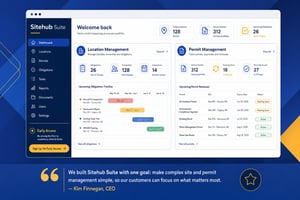
Sitehub Suite is a connected, location-centric solution designed to help multi-location organizations manage the responsibilities, deadlines, documents and operational requirements associated with every site.
Instead of piecing together answers across spreadsheets, shared drives, inboxes and disconnected tools, teams gain a clearer and more consistent operational picture:
- What responsibilities and obligations exist at each location?
- Who owns them?
- When are they due?
- What is their current status?
- Where are the related documents and history?
Sitehub Suite is designed to work alongside the systems an organization already uses. It provides structure and visibility without requiring teams to replace their entire technology environment.
Products Designed for Different Operational Needs
Organizations can use the Sitehub Suite products that fit their needs today and expand over time.
- Sitehub Works Advanced lease administration and broader functionality for organizations managing complex multi-location portfolios. Sitehub Works helps teams maintain greater control over lease information, critical dates, financial obligations and the operational details connected to each location.
- Sitehub Locations A centralized operational record for every site, bringing essential location information, contacts, responsibilities, documents and history together in one place.
- Sitehub Permits Clearer visibility into licenses, permits, renewal requirements and deadlines across the portfolio, with the information teams need to manage compliance more proactively.
Together, these products help replace the spreadsheets-as-databases and email-threads-as-task-management that many organizations never intentionally chose, they simply grew into them.
Who Sitehub Suite Is Built For
Sitehub Suite is designed for the people responsible for keeping multi-location organizations running: operations directors, portfolio and real estate teams, facilities and compliance leaders, finance professionals and the executives who depend on accurate information from all of them.
That includes franchise organizations, retailers, restaurant groups, healthcare networks, service businesses and other organizations managing responsibilities across multiple locations.
If answering a basic question about one site requires several people, multiple spreadsheets or a search through years of email, Sitehub Suite was built with your organization in mind.
A More Connected Way to Manage Every Site
Sitehub Suite is more than another place to store information. It is a way to create greater clarity, accountability and continuity across an entire portfolio while preserving the flexibility to work with the systems and partners your organization already relies on.
All your sites. One suite.
Join the Preferred User List →GET STARTED
Request early access
Tell us a bit about your team and we'll be in touch about getting you set up.
LET'S CONNECT
Start a conversation
Have a question or want to learn more? Tell us how we can help and our team will be in touch.
SEE SITEHUB IN ACTION
Book a demo
Tell us a little about your organization and we'll help you schedule time to see Sitehub in action.
GET STARTED
Choose your plan
Select the plan that best fits your organization and tell us a little about your needs.
SITEHUB GROWTH GRANT
Apply to become a Charter Partner
Eligible franchisees with fewer than 25 locations may receive 12 months of complimentary access to Sitehub Suite. Tell us a little about your organization to get started.
